
La Jolla Short-Term Vacation Rental Permits: How San Diego’s STRO Licensing Works, What to Expect, and Why Professional Management Matters
La Jolla is one of San Diego’s highest-demand coastal markets for vacation rentals. Strong nightly rates and year-round travel demand make it attractive for homeowners—but La Jolla is governed by the City of San Diego’s Short-Term Residential Occupancy (STRO) program, which requires licensing, tax registration, and ongoing operational compliance before you rent for stays of less than one month. (San Diego Official Website)
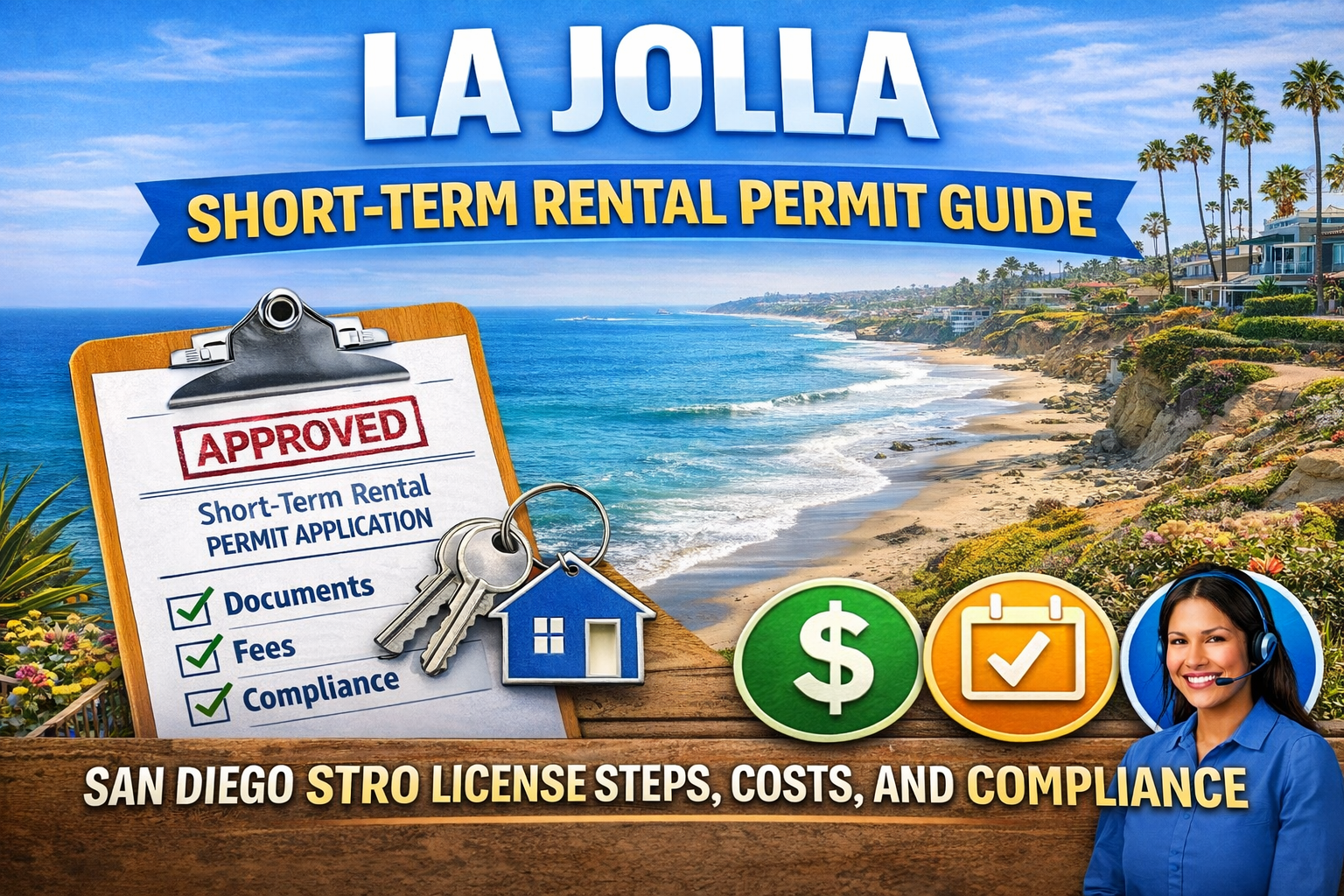
This guide is written for La Jolla homeowners and covers: (1) which STRO license tier likely applies to your property and business model, (2) how to apply step-by-step, (3) what owners should expect after approval, and (4) why professional management—such as Haustay Vacation Rentals—can reduce risk while improving performance.
1) First, confirm your property falls under the City of San Diego’s STRO rules
La Jolla is within the City of San Diego. The City’s STRO ordinance applies to rentals of a dwelling unit (or part of a dwelling unit) for less than one month within City limits. (San Diego Official Website)
Two critical implications for homeowners:
- If you rent for stays under one month, you need an STRO license (unless you qualify for a specific exemption under the municipal code). (San Diego Official Website)
- The City states it is unlawful to operate without an STRO license on or after May 1, 2023. (San Diego Official Website)
2) Choose the right STRO license tier for your La Jolla home
San Diego has four STRO license tiers, and a host may hold only one license at a time and may not operate more than one dwelling unit for STRO at a time. Licenses are not transferable between ownership or location. (San Diego Official Website)
Tier 1: Part-Time (20 days or less per year)
- Rented for an aggregate of 20 days or less per year
- Host does not need to reside onsite (San Diego Official Website)
Tier 2: Home Sharing (host resides onsite)
- Renting a room or rooms for more than 20 days/year, so long as the host resides onsite
- The City indicates the host may be absent from the permanent residence during whole-home STRO for up to 90 days per calendar year (San Diego Official Website)
- Operationally, Tier 2 is typically the best fit for owners who live in the home most of the year and want to rent rooms (and occasionally the whole home).
Tier 3: Whole Home (excluding Mission Beach)
- Rentals for more than 20 days/year where the host does not reside onsite (and the dwelling is not in the Mission Beach Community Planning Area) (San Diego Official Website)
- Capped: The number of licenses issued will not exceed 1% of San Diego’s total housing units outside Mission Beach. (San Diego Official Website)
- Two-night minimum stay required for guests. (San Diego Official Website)
Tier 4: Mission Beach Whole Home (not applicable to La Jolla)
Tier 4 applies only within the Mission Beach Community Planning Area, has a different cap (30%), and the City’s current update indicates the Tier 4 application period is closed. (San Diego Official Website)
3) What it costs (fees and license term)
San Diego’s STRO page publishes the current fee schedule and key timing:
- Fees (as of March 1, 2025):
- Tier 1: $33 application fee + $193 license fee
- Tier 2: $33 application fee + $284 license fee
- Tier 3: $41 application fee + $1,129 license fee (San Diego Official Website)
- Non-refundable fees (San Diego Official Website)
- Licenses expire two (2) years from date of issuance and may be renewed in accordance with the ordinance. (San Diego Official Website)
4) Step-by-step: How to apply for an STRO license for your La Jolla home
Step A: Get your prerequisites lined up before you start the STRO application
Before submitting, the City states you must have key items ready—including:
- An active Transient Occupancy Tax (TOT) Certificate (San Diego Official Website)
- An Active & Paid Rental Unit Business Tax (RUBT) Account (San Diego Official Website)
- A Business Tax Certificate (as applicable to your business structure) (San Diego Official Website)
- A Right-to-Occupy document if the host is not the property owner (e.g., a lease clause allowing STRO, or a signed owner statement). (San Diego Official Website)
The practical reason to handle these early: missing prerequisites are a common cause of application friction and delays.
Step B: Apply for (or confirm) your TOT certificate
If your property is rented to “transients” (occupancy for less than one month), the City requires obtaining a Transient Occupancy Registration Certificate. (San Diego Official Website)
The City also explains operators must collect TOT, hold it in trust, and remit monthly. (San Diego Official Website)
Important: San Diego’s TOT rates are now tax-zone based (effective May 1, 2025), with rates listed by zone (e.g., 11.75% to 13.75%), and the City provides a lookup map to determine the correct rate for a specific property address. (San Diego Official Website)
Step C: Submit the STRO license application online
San Diego directs applicants to the online STRO application portal. (San Diego Official Website)
During the application, you’ll enter host and local contact details, property information, and list each platform where the unit is advertised. (San Diego Official Website)
Step D: Upload required documents and pay fees
The City’s application guide notes documents that may need to be attached include items such as:
- Right to Occupy
- Booking activity
- Proof of TOT payment (San Diego Official Website)
5) What homeowners should expect after approval: operational rules are ongoing, not “one-and-done”
A common misconception is that the permit is the hard part and operations are easy. In reality, San Diego’s STRO program expects ongoing compliance and recordkeeping.
Key examples from the City’s host operating requirements checklist:
- Tier 2 primary residence requirement: utilize the dwelling as the host’s primary residence no less than 275 days per calendar year. (San Diego Official Website)
- Tier 3 utilization requirement: use the license a minimum of 90 days each year and ensure each guest has occupancy for a minimum of two consecutive nights. (San Diego Official Website)
- Recordkeeping: maintain records of STRO activity (dates, nights booked, gross receipts) for four (4) years. (San Diego Official Website)
- Quarterly reporting: the City notes quarterly reports are required for Tier 3 (and Tier 4) hosts. (San Diego Official Website)
- Human trafficking awareness: hosts must post guest guidance and maintain proof of training completion. (San Diego Official Website)
These requirements are operationally manageable, but they require systems—especially for whole-home operators who aren’t local day-to-day.
6) Why professional management (like Haustay) matters for La Jolla STRO operators
La Jolla is a premium market. Guests expect hotel-grade execution—and the City expects compliance-grade operations. Professional management delivers leverage in three specific categories:
1) Licensing, tax, and business-account coordination
Successful STRO licensing in San Diego is not just the STRO application. It also involves TOT registration, RUBT compliance, and business tax documentation, plus renewal timing and ongoing filings. (San Diego Official Website)
Haustay helps owners coordinate these moving pieces so you avoid preventable delays and compliance gaps.
2) Compliance-by-design operations
A professional manager builds repeatable operating procedures that align with the City’s requirements—record retention, platform listing governance, minimum stay settings (especially for Tier 3), and documentation readiness if the City requests information. (San Diego Official Website)
3) Better guest experience and stronger net performance
In La Jolla, small details materially impact revenue and reviews: responsive guest communications, high-standard cleaning, preventative maintenance, clear parking instructions, and calm neighbor-compatible operations. Professional management makes performance consistent rather than dependent on the owner’s availability.
Bottom line: La Jolla is a high-opportunity market—if you operate it like a regulated hospitality business
If you own a home in La Jolla and want to rent it for stays under one month, you should plan for (1) STRO licensing, (2) TOT registration and monthly remittance at the correct zone rate, and (3) ongoing operational requirements like minimum stays (Tier 3), utilization thresholds, quarterly reporting, and multi-year recordkeeping. (San Diego Official Website)
If you want, share whether your La Jolla property will be owner-occupied (home sharing) or whole-home, and I can map your most likely tier and provide a practical checklist of what to assemble before you start the City application—aligned to the City’s published prerequisites and operating requirements.